Embroidery vs Printing: Which Suits Your Logo?
Embroidered or printed logo? How each method works, how they compare on look, detail and durability, and which suits polos, hoodies, T-shirts and workwear.
Guides5 min read
Every branded clothing order comes to the same question sooner or later: should the logo be embroidered or printed? The answer changes how the garment looks, how it feels, how it washes and which artwork you can use. This guide explains how each method works, compares them point by point and shows which one suits each garment. It is written by Desa & Co, a clothing manufacturer in Tirana that does both embroidery and DTF printing in its own workshop.
The short answer: embroidery is best for small logos on polos, jackets and workwear that is washed often; printing is best for large designs, many colours and fine detail. You can also use both: a small embroidered logo on the chest and a larger print on the back.
Key takeaways
Embroidery stitches the logo into the fabric with thread: textured, premium and able to stand up to frequent hot washes.
Printing puts the design on top of or into the fabric: full colour, fine detail and large sizes.
Choose by the garment and the artwork, not by habit: a small chest logo suits thread, a large back design suits print.
Send a vector logo either way; it makes both methods sharper.
How embroidery works
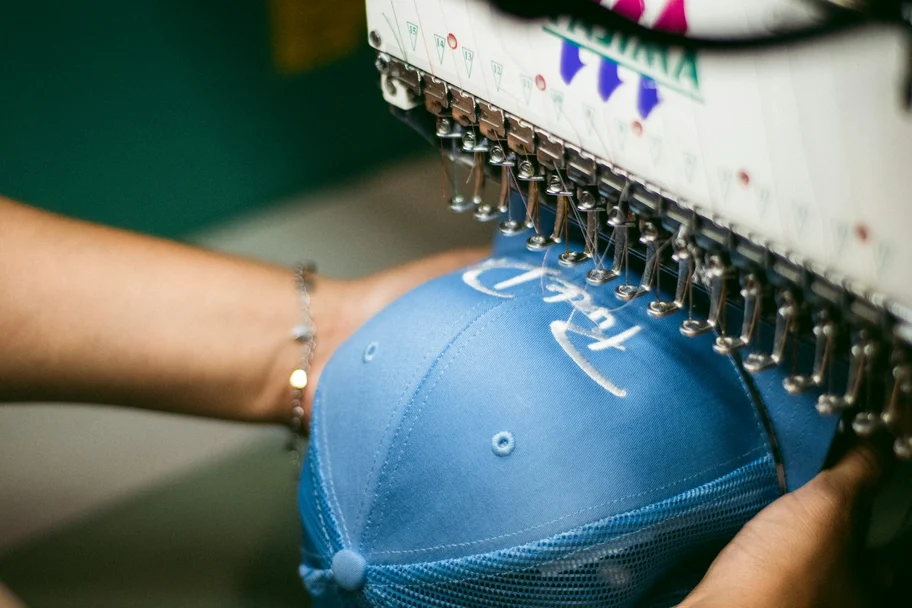
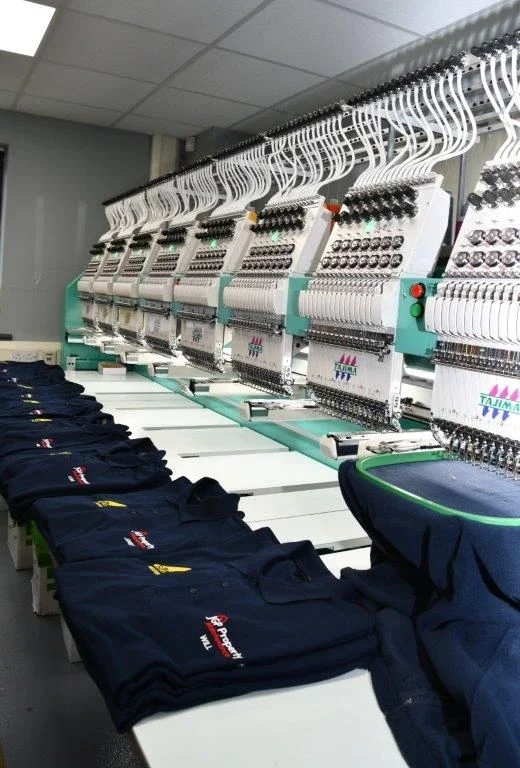
In embroidery the logo is not printed but sewn. First the artwork is turned into an embroidery file, a step called digitising, which sets every stitch, its direction and the order of the thread colours. A multi-head embroidery machine then stitches the same logo onto several garments at once, each head following the file.
Because the thread becomes part of the fabric, embroidery has no ink layer to crack or peel, and it stands up well to frequent hot washes. The raised texture is what makes a polo or jacket look like a uniform rather than a souvenir. Its limits are detail and size: very small lettering, gradients and photographic images do not translate into thread, and large solid areas become heavy and stiff.
How printing works
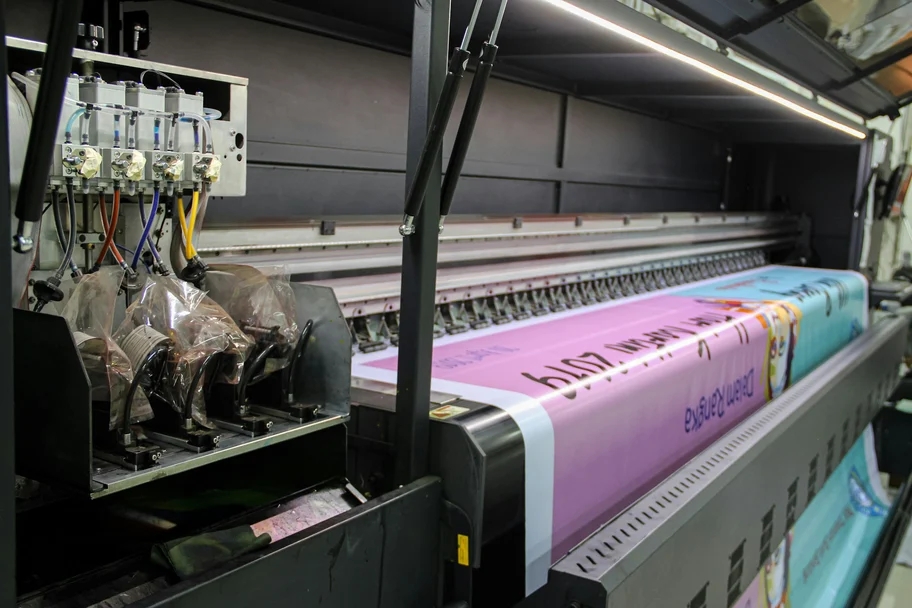
Printing covers several methods. Three are common for branded clothing:
- DTF (direct-to-film): the design is printed onto a film, coated with adhesive powder, cured and heat-pressed onto the garment. It handles full colour on almost any fabric, light or dark (Epson; Ink Experts).
- Screen printing: ink is pushed through a mesh screen, and a new screen is needed for each colour (Thames & Hudson), so it suits simple designs in few colours.
- Sublimation: a dye-based method that only works on polyester fabrics and gives the best results on white or light polyester (Epson). It is the method we use for all-over team kits.
Print sits on or in the fabric as a thin layer rather than raised thread, so it can reproduce gradients, photographs and small text that thread cannot. DTF is the method we print with in house; our guide to DTF printing explains it in detail.
Embroidery vs printing, point by point
Embroidery | Printing (DTF) | |
|---|---|---|
Look | Raised, textured, premium | Smooth layer on the surface, vivid colour |
Colours and detail | Solid thread colours, no gradients | Full colour, gradients, fine detail |
Best logo size | Small to medium: chest, sleeve | Medium to large: back, front panel |
Washing | Stands up well to frequent hot washes | Follow the care label: wash inside out, no iron on the print |
Best garments | Polos, shirts, jackets, fleece | T-shirts, hoodies, event and sports tops |
Typical use | Uniforms worn every day | Events, campaigns, merch, large designs |
When to choose embroidery
Embroidery is the better choice for:
- Polo shirts and shirts for customer-facing staff: see our embroidered polo shirts
- Workwear, chef jackets and scrubs that go through hot washes every week: see custom workwear
- Fleece and jackets, where stitching suits the thicker, textured fabric
- Simple logos with a few solid colours, at chest size
When to choose printing
Printing is the better choice for:
- Large designs on the back of T-shirts and hoodies: see bulk custom T-shirts and custom hoodies
- Logos with gradients, photographs or very fine lettering
- Event, campaign and sponsor T-shirts with several logos
- Sports kits printed all over, where sublimation is the method: see custom football kits
Combining embroidery and print on one garment
You do not have to choose one method for a whole order. One option is a small embroidered logo on the chest, which gives the garment a premium finish, and a larger printed design or message on the back, where print handles size and colour better. Because we do both in house, combining them on the same garment does not add another supplier to the job.
How to prepare your logo
Whichever method you choose, send us:
- Send a vector file (PDF, AI or SVG). It gives the cleanest embroidery file and the sharpest print.
- Give exact colours, ideally Pantone references, so thread and ink can be matched.
- Say the size and position of each logo, for example 8 cm on the left chest and a full back print.
- Simplify for thread: if your logo has very fine detail, a simplified version for embroidery keeps it legible.
Ordering from Desa & Co
We are a clothing manufacturer in Tirana, Albania, and we embroider and DTF print in our own workshop. Our minimum is 100 to 150 pieces per product, production of the minimum quantity takes 2 weeks after sample approval, and we deliver to the United Kingdom, Italy and across Albania. We are certified to ISO 9001, ISO 14001 and ISO 45001, and our cotton is certified to OEKO-TEX® Standard 100. Send us your logo and quantities and we will recommend embroidery, printing or both with your quote.
Frequently asked questions
Is embroidery or printing more durable?
Embroidery stands up very well to frequent hot washes because the thread is part of the fabric. How long a print lasts depends on the method and on care: washing inside out and not ironing over the design protects it. For uniforms washed every day, embroidery is the safer choice.
Can any logo be embroidered?
Most can, but very fine lines, tiny text and gradients do not work in thread. In those cases we suggest a simplified version for embroidery or printing instead.
Which is better on a hoodie?
Embroidery for a logo on the chest, printing for a large design on the back. A hoodie can carry both.
Can you embroider and print the same garment?
Yes. We do both in our own workshop, so one garment can carry an embroidered chest logo and a printed back design.
Need clothing made for your team?
Send us the product, the quantity and your logo, and we will reply with a quote and a delivery date.
Request a quoteKeep reading
Private Label Clothing Manufacturer: Low MOQ
How private label clothing works with a manufacturer: your designs and labels, made in someone else's factory. The steps, the minimums, the labels you need and a real UK order.
What Is DTF Printing? A Buyer's Guide
How direct-to-film (DTF) printing works, which fabrics and designs it suits, how it compares with screen printing, sublimation and embroidery, and how to prepare artwork for it.
How to Design a Football Kit for Your Club
Colours, crest, sponsors, numbers and fabric: how to design a football kit that looks right, follows the rules and can actually be made, from a manufacturer that sublimates club kits.