What Is DTF Printing? A Buyer's Guide
How direct-to-film (DTF) printing works, which fabrics and designs it suits, how it compares with screen printing, sublimation and embroidery, and how to prepare artwork for it.
Guides6 min read
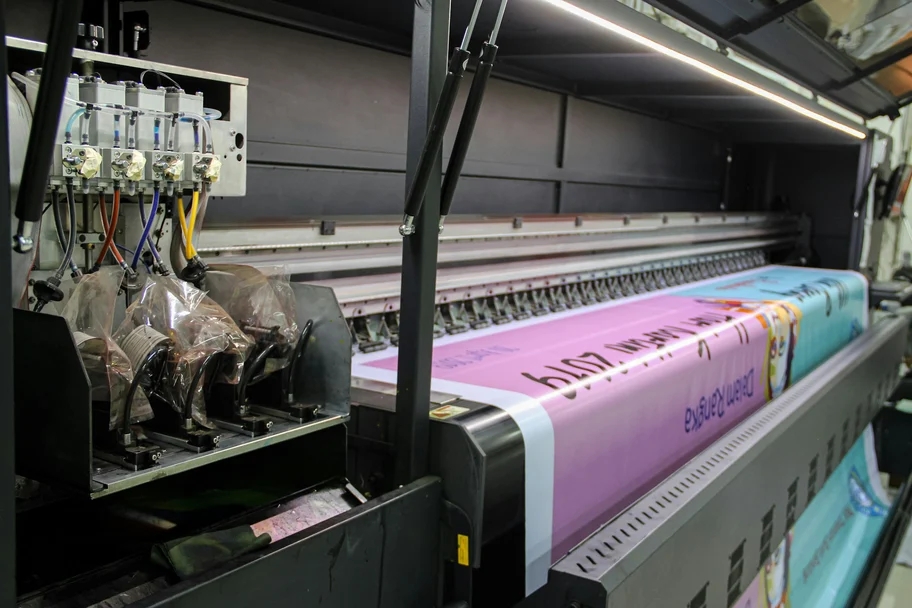
DTF printing is a widely used way to put a logo or design on T-shirts, hoodies and workwear. This guide explains how it works, where it falls short and how it compares with screen printing, sublimation and embroidery, so you can choose the right method for your order. It is written by Desa & Co, a clothing manufacturer in Tirana that does DTF printing and embroidery in house.
The short answer: DTF stands for direct-to-film. The design is printed onto a special film, coated with an adhesive powder, cured, and then heat-pressed onto the garment. It prints full colour on light and dark fabrics, on cotton, polyester and blends, without a separate screen for each colour.
Key takeaways
DTF prints the design on film, then heat-presses it onto the garment.
It handles full-colour designs on almost any fabric and on dark garments.
There is no screen per colour, so many-colour designs and mixed designs in one order are practical.
The print sits on the fabric and has a slightly raised feel; embroidery or sublimation can suit some jobs better.
How DTF printing works
DTF is a transfer method: the design is made on film first and moved onto the garment afterwards. Equipment and settings vary by machine, but the steps are the same (Epson, DTG and DTF printing; Ink Experts, What is DTF printing):
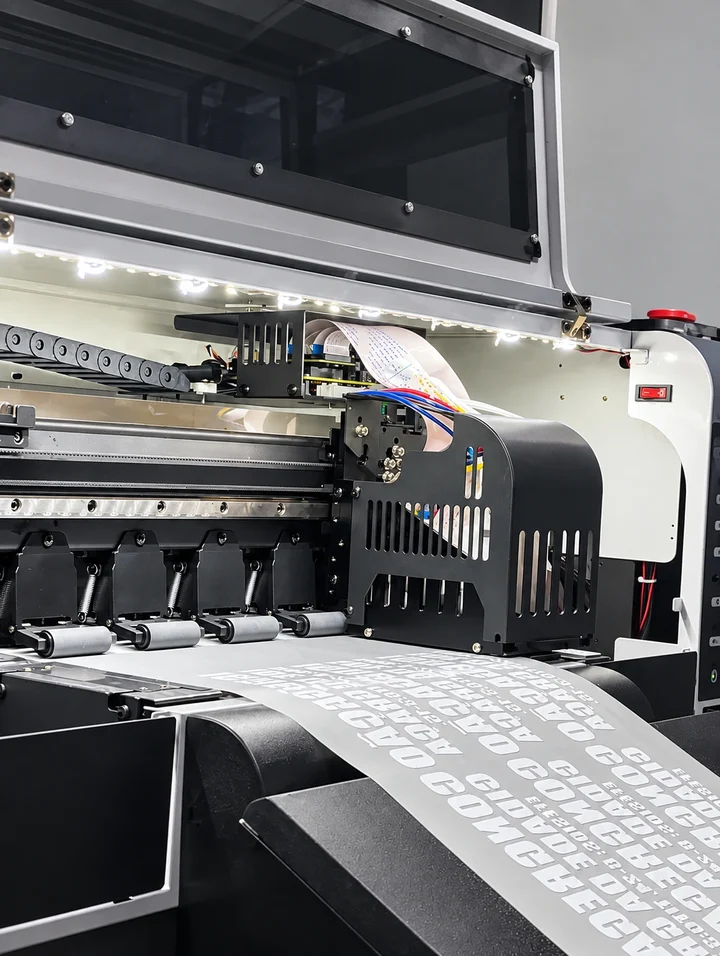
- Print: the design is printed in colour (CMYK) onto a PET film, with a layer of white ink behind it so the colours stay bright on dark fabric.
- Powder: while the ink is still wet, an adhesive powder is applied; it sticks to the printed areas only.
- Cure: the powder is melted with heat, turning the print into a ready-to-use transfer.
- Press: the transfer is placed on the garment and heat-pressed, then the film is peeled away, leaving the design on the fabric.
Because the design is printed on film rather than on the garment, many different designs and sizes can be printed together on one sheet and pressed onto different garments afterwards.
What DTF printing is good at
- Full colour: gradients and many-colour logos print in full colour, including white (Ink Experts).
- Dark and light garments: the white underlayer keeps colours bright on black, navy or red fabric.
- Many fabrics: Epson describes direct-to-film as working on almost any fabric and, of its two garment printing methods, recommends it over direct-to-garment for polyester (Epson, DTG and DTF printing). We print it on cotton T-shirts, poly-cotton polos and fleece hoodies.
- No screens to make: screen printing needs a new screen for each colour (Thames & Hudson, How screenprints are made). DTF does not, which makes multi-colour designs and several different designs in one order practical.
- Placement: front, back, sleeves and smaller areas such as a chest logo are all possible.
Where DTF falls short
DTF is not the best choice for every job. The print is a layer that sits on top of the fabric, so it has a slightly raised feel; Epson notes that it feels more raised than direct-to-garment printing (Epson). The bigger and more solid the print, the more of the garment carries that layer, so for T-shirts worn all day an open design or a smaller print is worth considering. And a printed logo, however well made, does not give the textured, premium look that embroidery does on a polo shirt or a jacket.
DTF vs screen printing, sublimation and embroidery
Method | How it works | Fabrics | Best for |
|---|---|---|---|
DTF printing | Design printed on film, then heat-pressed onto the garment | Almost any fabric, light or dark | Full-colour logos, back prints, mixed designs |
Screen printing | Ink pushed through a mesh screen, one screen per colour | Most fabrics, with a suitable ink | Simple designs in few colours |
Sublimation | Dye is transferred into the polyester fibre with heat | Polyester only, best on white or light colours | All-over prints, sportswear, team kits |
Embroidery | Logo stitched into the fabric with thread | Most fabrics with enough body | Chest logos on polos, jackets, workwear |
Sublimation only works on polyester fabrics, and works best on white or light-coloured polyester (Epson, sublimation printing). That is why we use it for football and team kits, which are polyester, and DTF for printed cotton and dark garments. Our guide to polyester vs cotton explains which fabric suits which method, and our football kit design guide covers sublimated kits.
How we choose between DTF and embroidery
We do both in house, so we recommend the method that suits each garment and design rather than the one we happen to have:
- DTF for large back prints, full-colour artwork and designs with many colours or fine gradients, on bulk custom T-shirts and custom hoodies.
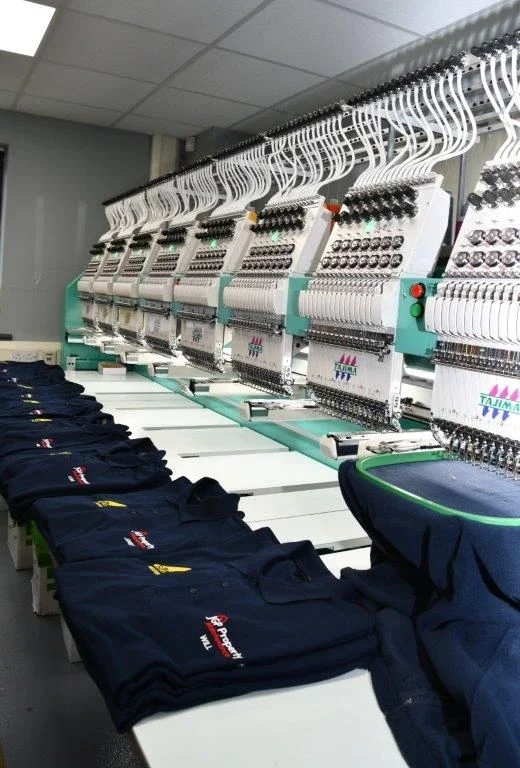
- Embroidery for small chest logos on embroidered polo shirts, jackets and workwear, where embroidery stands up well to frequent hot washes.
- Both together: a small embroidered logo on the chest and a large DTF print on the back.
How to prepare artwork for DTF
- Send a vector file (PDF, AI or SVG) or a high-resolution image at the size it will be printed.
- Use a transparent background, so nothing prints around the design that you did not intend.
- Give exact colours, ideally Pantone references; DTF prints in CMYK plus white, so we match them as closely as the process allows and you approve the colours on the sample.
- Say the size and position of each print: for example, a chest logo and a full back print.
Fabric weight matters too: our guide to GSM explains what fabric weight means; DTF works across the range, from light T-shirts to heavy fleece hoodies.
Caring for DTF prints
Follow the garment's care label, wash it inside out and don't iron directly over the print. Like any decoration, a DTF print lasts longest when it is not exposed to very high heat.
Ordering printed garments from Desa & Co
We are a clothing manufacturer in Tirana, Albania. Our minimum is 100 to 150 pieces per product, production of the minimum quantity takes 2 weeks after sample approval, our cotton is certified to OEKO-TEX® Standard 100, and production is certified to ISO 9001, ISO 14001 and ISO 45001. We deliver to the United Kingdom, Italy and across Albania. Send us your design and quantities and we will recommend DTF, embroidery or sublimation with your quote.
Frequently asked questions
What does DTF stand for?
DTF stands for direct-to-film: the design is printed onto a film and then transferred onto the garment with heat and pressure.
Does DTF printing work on polyester?
Yes. DTF works on cotton, polyester and blends, and Epson recommends it over direct-to-garment printing for polyester.
Is DTF better than screen printing?
It depends on the design. DTF suits full-colour artwork and orders with several different designs, because it needs no screen for each colour. Screen printing suits simple designs in few colours.
What is the difference between DTF and sublimation?
DTF adds a printed layer on top of the fabric and works on almost any fabric, light or dark. Sublimation dyes the design into the fibre, so it adds no layer on top, but it only works on polyester and works best on white or light colours.
What is the difference between DTF and DTG?
DTG (direct-to-garment) prints straight onto the garment, which has to be pre-treated first; DTF prints onto film and is then heat-pressed on. Epson notes that DTF has a more raised feel than DTG, and recommends DTF for polyester (Epson).
Should I choose DTF or embroidery for my logo?
Embroidery suits small chest logos on polos, jackets and workwear; DTF suits large prints and artwork with many colours. You can also combine both on one garment.
Need clothing made for your team?
Send us the product, the quantity and your logo, and we will reply with a quote and a delivery date.
Request a quoteKeep reading
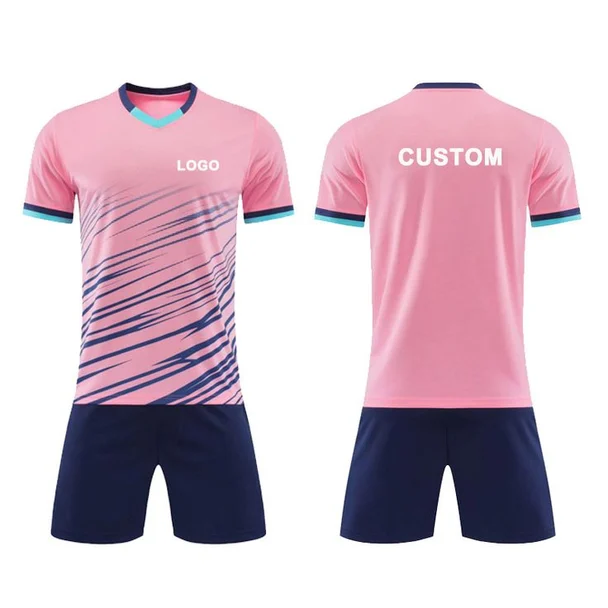
How to Design a Football Kit for Your Club
Colours, crest, sponsors, numbers and fabric: how to design a football kit that looks right, follows the rules and can actually be made, from a manufacturer that sublimates club kits.
GSM Meaning: Fabric Weight in Clothing Explained
What GSM means on a T-shirt, polo or hoodie, how it is measured and converted to ounces, what it does and doesn't tell you about quality, and which weight to choose for uniforms and merch.
Polyester vs Cotton for Work Uniforms
Cotton, polyester or a polycotton blend? How each fabric wears, washes and lasts in a work uniform, and which one suits offices, kitchens, clinics, sites and sports teams.