
Hi-Vis Classes Explained: EN ISO 20471
What EN ISO 20471 requires of hi-vis clothing: the three classes and their minimum areas, permitted colours, combining a jacket and trousers, adding logos, and CE and UKCA marking in Great Britain.
Guides7 min read
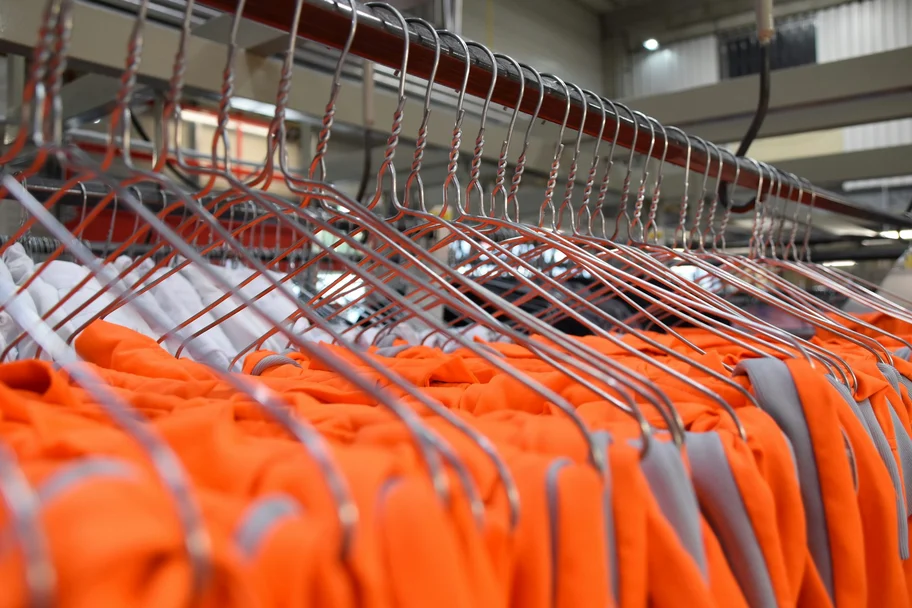
If your team works near traffic, on a building site, in a warehouse or beside a railway, the hi-vis they wear should carry EN ISO 20471 on its label, with a class number next to it. What that number means, which class you need, whether a jacket and trousers add up to a higher class and whether you can put your logo on certified hi-vis are the questions this guide answers, from the standard's published requirements and UK guidance. It is written by Desa & Co, a clothing manufacturer in Tirana that makes hi-vis workwear to the standard and class the buyer specifies.
The short answer: EN ISO 20471 is the international standard for high-visibility clothing, and it sorts garments into three classes by the minimum area of fluorescent and retroreflective material they carry, with Class 3 the most visible and Class 1 the least. In the UK it is published as BS EN ISO 20471:2013+A1:2016 (BSI).
Key takeaways
Class 3 needs at least 0.80 m² of fluorescent and 0.20 m² of retroreflective material; Class 2 needs 0.50 and 0.13 m²; Class 1 needs 0.14 and 0.10 m².
The standard defines three colours: fluorescent yellow, orange-red and red. GB mainline rail work requires orange.
Two Class 2 garments only make Class 3 if the manufacturer has tested and labelled them as a combination.
Logos are allowed only where they don't reduce the certified areas; plan them before production.
What is EN ISO 20471?
ISO 20471, "High visibility clothing: Test methods and requirements", was first published in March 2013 and sets requirements for hi-vis clothing together with the test methods used to confirm compliance (Wikipedia). A hi-vis garment works in two ways: fluorescent background material makes the wearer stand out in daylight, and retroreflective material bounces vehicle headlights back towards the driver in the dark. HSE notes that the darker the conditions or worksite, the more hi-vis clothing is required, and that retroreflective material may be needed to be seen in headlights or darkness (HSE).
The three hi-vis classes
Each class sets a minimum area of fluorescent background material and of retroreflective material. The figures below come from Centexbel, the Belgian textile research centre that tests garments to the standard (Centexbel).
Class | Fluorescent background | Retroreflective | Typical use |
|---|---|---|---|
Class 3 | 0.80 m² minimum | 0.20 m² minimum | High-speed roads, night work on highways |
Class 2 | 0.50 m² minimum | 0.13 m² minimum | Road works, urban construction |
Class 1 | 0.14 m² minimum | 0.10 m² minimum | Low-risk settings, such as off-road work |
Three details decide the class in practice. The areas are measured on the smallest size in the range, with fasteners closed to their smallest setting, and the class is set by the lowest measured area (HAZTEC). Class 1 garments may alternatively use 0.20 m² of combined performance material (NITRAS). And regardless of the area, a Class 3 garment, or tested combination, must cover the torso and have sleeves or full-length legs with retroreflective bands (SIP Protection).
What is hi-vis Class 2?
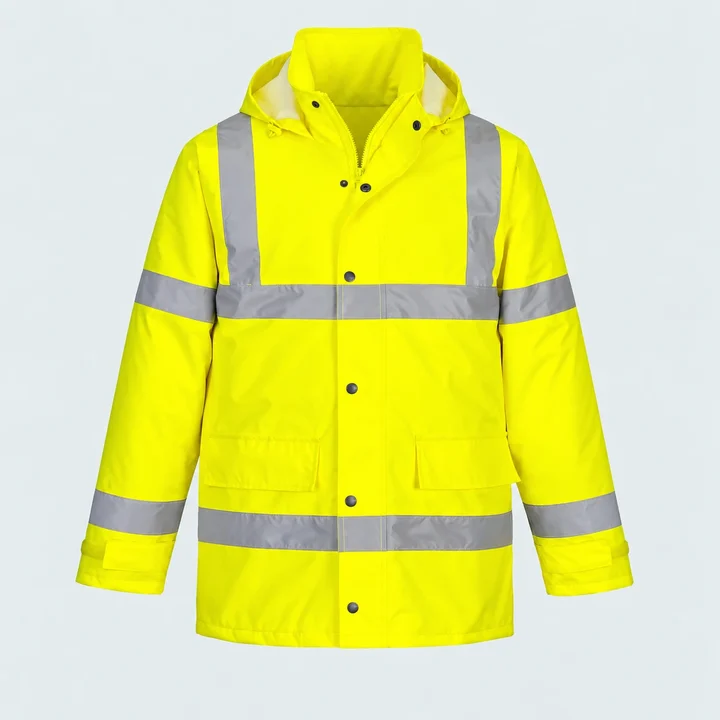
Class 2 is the middle class: at least 0.50 m² of fluorescent material and 0.13 m² of retroreflective material. Centexbel lists road works and urban construction as typical Class 2 settings. It is also the minimum for the GB mainline railway: RIS-3279-TOM, the rail industry standard for hi-vis, requires garments to meet at least Class 2 of EN ISO 20471 (SATRA). Because Class 3 needs banded sleeves or banded trousers, a vest or a short-sleeved polo usually tops out at Class 2.
Hi-vis colours
EN ISO 20471 defines three fluorescent colours: yellow, orange-red and red (SATRA). The background material is tested for colourfastness and chromaticity, including after UV exposure and washing (Centexbel). For general site and transport work, HSE suggests that day-glo or fluorescent yellow is likely to be best (HSE). Rail is the exception: RIS-3279-TOM specifies an orange colour, and its garments must include both fluorescent and retroreflective materials (SATRA).
Combining a jacket and trousers
A common mistake is to assume that two Class 2 garments make Class 3. They can, but only as a tested combination: NITRAS gives the example of a Class 2 jacket worn with Class 2 trousers reaching Class 3, and stresses that the combination must be tested by the manufacturer and labelled accordingly, for example "X + Y = class 3" (NITRAS). HAZTEC gives another example, a Class 2 jacket that reaches Class 3 when worn with its Class 1 trousers (HAZTEC). A jacket from one supplier and trousers from another, never tested together, keep their own classes.
NITRAS also points out that visible areas must not be covered in use by backpacks, tools, equipment or dirt, which is worth remembering when you choose tool belts and harnesses.
Can you put a logo on hi-vis?
Yes, within limits. Logos can be applied providing the minimum area is not reduced or compromised by their presence (HAZTEC). Manufacturers publish how much space that leaves: MASCOT certifies one Class 1 long-sleeve T-shirt for a maximum logo area of 0.22 m², with logos on the front or back each limited to 50% of that area and a left-breast logo of up to 12 x 10 cm (MASCOT). On rail hi-vis, the visible materials must not be compromised by company names or logos (SATRA).
The practical rule is to decide the logo, its size and its position before the garment is made and certified, rather than adding it to finished hi-vis afterwards. Our guide to embroidery vs printing explains how the two methods differ.
Labels, CE and UKCA marking and the law
Under the Personal Protective Equipment at Work Regulations 1992, among other conditions, PPE is only suitable if it is appropriate for the risks involved, fits the wearer and complies with the legal requirements that apply to it, including Regulation 2016/425 on PPE (legislation.gov.uk). Since 6 April 2022 those duties also cover limb (b) workers: employers must assess suitability, provide the PPE free of charge and look after its maintenance, storage and replacement (HSE).
On marking, Great Britain recognises the CE mark indefinitely, so hi-vis can carry either CE or UKCA marking on the GB market; for Northern Ireland and the EU, the CE marking remains mandatory (GOV.UK). The mark shows the garment conforms to the PPE rules, but HSE warns that it does not mean the clothing is suitable for every situation (HSE). Check the label for the standard, the class and, where smaller sizes reach only a lower class, which sizes that applies to.
Hi-vis workwear from Desa & Co
We make hi-vis to the standard and class you specify, and before production we supply a sample for you to have tested; we don't hold a hi-vis certificate of our own, so agree with us before ordering who arranges the testing and the CE or UKCA marking. We agree the logo position with you before production, so you can check on the sample that your requirements are met. See our custom workwear for the rest of the range. Our minimum is 100 to 150 pieces per product, with sizes and colours mixed within it, production of the minimum quantity takes 2 weeks after design approval, and we deliver to the United Kingdom, Italy and across Albania. Tell us the standard, class and quantities you need.
Frequently asked questions
What is the difference between hi-vis Class 2 and Class 3?
Class 3 needs more material, at least 0.80 m² of fluorescent and 0.20 m² of retroreflective material instead of 0.50 and 0.13 m², and it must cover the torso and have banded sleeves or banded full-length legs, alone or as a tested combination.
Do two Class 2 items make Class 3?
Only if the manufacturer has tested them together and labelled the combination as Class 3. Otherwise each garment keeps its own class.
Who decides which hi-vis class is needed?
The employer, as part of the PPE suitability assessment for the job. Some sectors set a minimum, such as Class 2 in orange for GB mainline rail.
Can I put my company logo on hi-vis?
Yes, as long as the logo does not reduce the fluorescent and retroreflective areas below the certified minimum. Agree the logo area and position with the manufacturer before production.
Is CE marked hi-vis still valid in the UK?
Yes. Great Britain recognises CE marking indefinitely, alongside UKCA. In Northern Ireland the CE marking remains mandatory.
Need clothing made for your team?
Send us the product, the quantity and your logo, and we will reply with a quote and a delivery date.
Request a quoteKeep reading
What Is Sublimation Printing on Clothing?
How dye sublimation works, from transfer paper to heat press, why it needs white or light polyester, its strengths and limits, how it compares with DTF and embroidery, and why football kits are made this way.
Uniform Tax Rebate: Who Can Claim and How
A plain-English summary of the UK uniform tax rebate: who qualifies, what counts as a uniform for HMRC, the flat rate amounts by job, how to claim for the current tax year and the 4 previous ones, and what it means for employers ordering branded uniforms.

How to Wash Work Uniforms and Keep Logos Sharp
How to wash branded polos, T-shirts, hoodies, workwear, hi-vis, scrubs and chef whites so the logo and the colour last: care labels, temperatures, drying, ironing and who washes PPE.