
Why Do Chefs Wear White? Chef Whites Explained
Why chefs wear white, where chef whites come from (Carême, Escoffier and the toque), why the jacket is double-breasted, the main types of aprons and what chefs wear today.
Guides6 min read
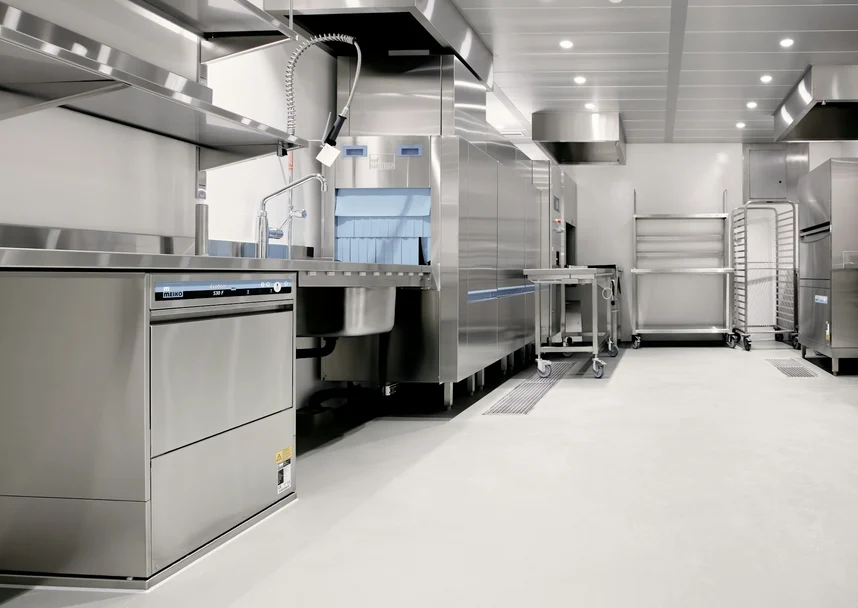
Walk into a professional kitchen and the head chef is often in a white, double-breasted jacket, the uniform known as chef whites. White is an odd choice for a job full of sauces, grease and splashes, so why do chefs wear it? This guide covers the history, the reasons behind each part of the uniform, the main types of aprons and what kitchens wear today. It is written by Desa & Co, a clothing manufacturer in Tirana that makes chef jackets and aprons for restaurants and hotels.
The short answer: chefs wear white because it signals cleanliness: a white jacket shows every stain, so a clean one tells guests and colleagues that the kitchen is kept clean. The tradition took shape in 19th-century France, with the chef Marie-Antoine Carême (EHL Hospitality Business School).
Key takeaways
White is about cleanliness: it shows every mark, and white uniforms can be bleached.
Carême is credited with shaping the uniform in the 1820s; Escoffier made the tall pleated toque a sign of rank.
The double-breasted front can be reversed to hide a stain and gives two layers against spills, heat and steam.
Today chefs also wear black, grey and coloured jackets, usually in cotton or poly-cotton.
Where chef whites come from
Cooks covered their heads long before anyone wore chef whites. The toque most likely evolved gradually from the head coverings cooks wore over the centuries, and Boucher, the personal chef of the French statesman Talleyrand, is credited as the first to insist on white toques for sanitary reasons (Wikipedia: Toque).
The uniform as we know it is credited to Marie-Antoine Carême (1784 to 1833), often described as the first celebrity chef (EHL). He is said to have stiffened the cook's soft cap with cardboard to create the tall toque (Wikipedia: Toque), and the double-breasted jacket appears in the illustrations of his 1822 book, credited with promoting the elements of the modern chef's uniform (Culinary Institute of America). The book is Le Maître d'hôtel français (Wikipedia: Marie-Antoine Carême).
Later in the century, Auguste Escoffier (1846 to 1935) favoured the tall, starched and pleated hat that became known as la toque blanche, and used different toque heights to show rank in the kitchen (Culinary Institute of America). He also brought the chef's coat to London, where he ran the restaurants of the Savoy and then the Carlton Hotel (Wikipedia: Chef's uniform). The Culinary Institute of America notes that top chefs today wear toques about 12 inches (30 cm) tall and apprentices about 8 inches (20 cm), and repeats the legend that the roughly 100 pleats stand for the number of ways a chef can cook an egg. It is a legend, not a rule.
Why white?
The sources agree on one main reason and add a few practical ones:
- Cleanliness you can see. White is the most revealing colour for stains, which keeps cooks careful and shows guests a clean kitchen (EHL). An all-white uniform gives an impression of cleanliness and purity (Culinary Institute of America).
- It can be bleached. White uniforms can be bleached, so stains can be removed without replacing the whole uniform, as the uniform-laundry company Alsco points out.
- Heat. EHL's executive chef adds that white reflects heat better than darker fabrics, helping chefs stay cooler (EHL).
- Hygiene under the hat. The white toque kept hair up and out of the food and absorbed some of the sweat from a hot brow (Culinary Institute of America).
Why the jacket is double-breasted
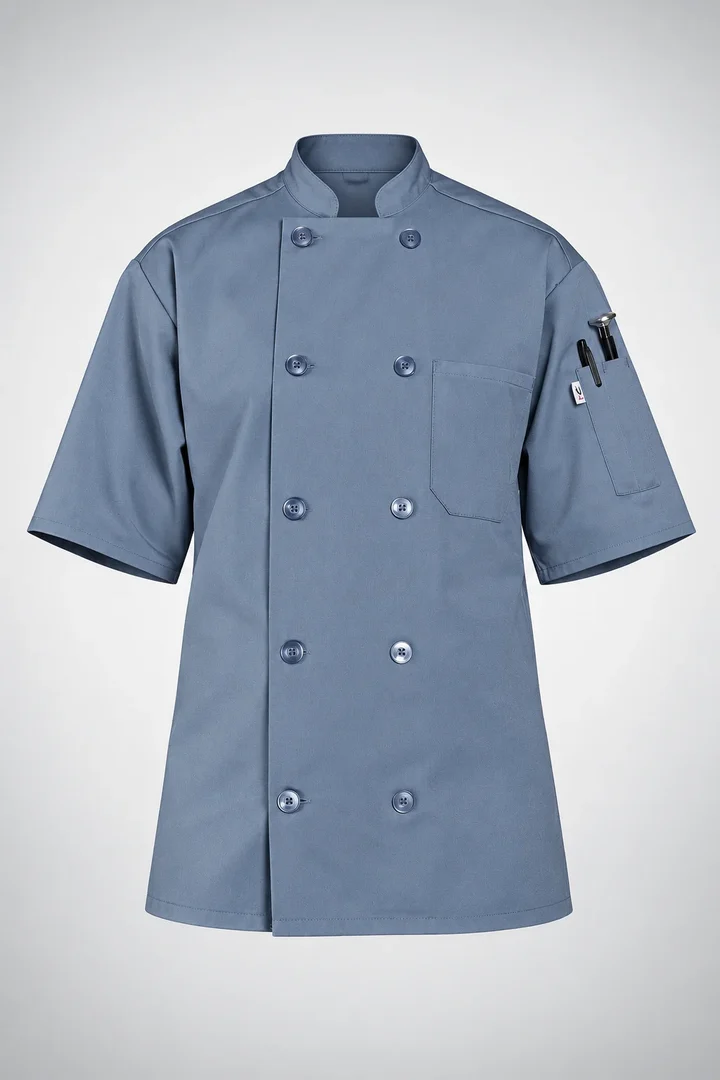
The double-breasted front is practical rather than decorative. If the front of the jacket gets dirty, the flaps can be reversed, and the overlap gives two layers of protection from spills, splashes, heat and steam (Culinary Institute of America). The same source notes that because the jacket buttons either way, it suits men and women equally. Traditional jackets were made of thick cotton to protect against the heat of stoves and splashes of boiling liquid, and knotted cloth buttons were used because they survived frequent washing and contact with hot items (Wikipedia: Chef's uniform).
The rest of the classic uniform follows the same logic, as the table shows.
Part | Traditional form | What it is for |
|---|---|---|
Jacket | White, double-breasted, thick cotton | Shows cleanliness; reversible front; protection from heat and splashes |
Toque | Tall, pleated, white | Keeps hair out of the food; height traditionally showed rank |
Trousers | Small check or houndstooth | The pattern disguises stains |
Neckerchief | Tied at the neck | Absorbed sweat in very hot kitchens |
Apron | Long, worn over the jacket | Protects the uniform and the chef from spills |
Sources for the trousers, neckerchief and apron: the Culinary Institute of America, which also quotes an 1892 London cookery class: reversing the apron once was permissible, and stains could be hidden by adjusting the folds over the waist string.
What chefs wear today
White has not disappeared, but it is no longer the only option. Other colours, such as black, are increasingly popular (Wikipedia: Chef's uniform), and EHL notes a clear shift towards black, grey and even boldly coloured uniforms, with white still common for executive chefs and formal service (EHL). Jackets are usually made from cotton or poly-cotton blends (WebstaurantStore); our guide to polyester vs cotton for work uniforms explains how the two fibres behave in daily washing.
Types of aprons
Aprons are the other half of a kitchen uniform. In professional kitchens the long, wide apron is worn mainly for safety, absorbing hot spills before they reach the chef (Wikipedia: Chef's uniform), and chef aprons are typically longer than ordinary ones, reaching the knees or lower (WebstaurantStore). The main types are these (Wikipedia: Apron; WebstaurantStore apron guide):
Type | What it covers | Where you see it |
|---|---|---|
Bib apron | Upper and lower body; also called the French chefs' apron | Kitchen staff, servers and butchers |
Bistro apron | From the waist down, long | Front-of-house staff |
Waist (server) apron | From the waist down, shorter | Servers and bussers, not the kitchen |
Tabard (cobbler apron in the US) | Front and back, fastened at the sides | Bakeries, hospitals and large shops |
Choosing chef jackets and aprons for a restaurant team
The history explains the uniform; a restaurant still has to decide what its own team wears. A few questions settle most of it:
- Who sees the kitchen? In an open kitchen the chef's jacket is part of the dining room, so colour and logo matter as much as in front of house.
- How is it washed? If you plan to bleach whites, choose a fabric whose care label allows it. If the uniform goes to a laundry service, ask what it can handle.
- Which apron for which role? Bib aprons cover the jacket for cooking; waist aprons leave the shirt visible for service staff.
- Where does the logo go? The chest and sleeve are the usual places for a logo; our guide to embroidery vs printing compares the two methods.
Chef jackets and aprons from Desa & Co
We make chef jackets and aprons as part of our hospitality uniforms for restaurants, hotels and cafés, with your logo embroidered in our own factory in Tirana. The minimum is 100 to 150 pieces per product, with sizes and colours mixed within it; production of the minimum quantity takes 2 weeks after design approval, and we deliver to the United Kingdom, Italy and across Albania. Tell us what your kitchen and floor teams need and we will come back with a quote.
Frequently asked questions
Why do chefs wear white?
Because white shows every stain, a clean white jacket signals a clean kitchen. White uniforms can also be bleached, and the tradition goes back to the French chef Marie-Antoine Carême in the early 19th century.
What are chef whites?
The traditional chef's uniform: a white double-breasted jacket, usually with a toque, checked trousers, a neckerchief and an apron.
Why are chef jackets double-breasted?
The front can be buttoned either way, so a stained flap can be hidden, and the double layer protects the chest from spills, heat and steam.
Why do chefs wear tall hats?
The toque keeps hair out of the food. Escoffier used different heights to show rank in the kitchen, and the tallest hat traditionally belongs to the head chef.
Why do some chefs wear black jackets?
Kitchens now use black, grey and coloured jackets as well as white (EHL), and a dark jacket does not show every mark during service.
Need clothing made for your team?
Send us the product, the quantity and your logo, and we will reply with a quote and a delivery date.
Request a quoteKeep reading
What Is Sublimation Printing on Clothing?
How dye sublimation works, from transfer paper to heat press, why it needs white or light polyester, its strengths and limits, how it compares with DTF and embroidery, and why football kits are made this way.
Uniform Tax Rebate: Who Can Claim and How
A plain-English summary of the UK uniform tax rebate: who qualifies, what counts as a uniform for HMRC, the flat rate amounts by job, how to claim for the current tax year and the 4 previous ones, and what it means for employers ordering branded uniforms.
How to Wash Work Uniforms and Keep Logos Sharp
How to wash branded polos, T-shirts, hoodies, workwear, hi-vis, scrubs and chef whites so the logo and the colour last: care labels, temperatures, drying, ironing and who washes PPE.