Logo Placement on Shirts and Uniforms: A Guide
Where should the logo go on a polo, T-shirt, hoodie, jacket or hi-vis vest? The common positions, typical sizes, embroidery or DTF for each, and how to brief your supplier.
Guides6 min read
You have the logo and the garments; now you need to decide where the logo goes and how big it should be. This guide is by Desa & Co, a clothing manufacturer in Tirana, Albania, that embroiders and DTF prints uniforms in its own workshop.
The short answer: put the main logo on the left chest, use the back for large prints and the sleeve or nape for a second mark, and agree the final size on a mock-up before production. For size, UK workwear supplier Essential Workwear quotes 8 to 10 cm wide for a chest logo. Left chest means the wearer's left, which you see on the right when facing them.
Key takeaways
Left chest is the default for polos, shirts, jackets and workwear; the back carries large designs and slogans.
Embroidery suits small chest, sleeve, nape and cap logos; DTF print suits large back designs and fine detail.
Typical sizes quoted by decorators are guides, not rules: the final size is agreed on the mock-up for your garment.
On hi-vis, the logo must not cover the fluorescent or reflective areas the garment needs for its class.
The common logo positions
These are the eight common places for a uniform logo:
- Left chest: the most popular placement and the one that suits almost any garment (Clothes2order).
- Right chest: it often carries a staff name (Essential Workwear), a department or a second logo, such as an accreditation.
- Sleeve: the upper arm takes a small logo, a flag or a web address; the forearm suits a short line of text.
- Back yoke (top back): just below the collar, for a logo, a name or a short line. Smaller logos tend to look more fitting there because of the neckline, Clothes2order notes.
- Full back: the high-visibility position, for a large logo, a slogan or a role such as STAFF or SECURITY that needs to be read from across a room or a site.
- Nape of the neck: a small, discreet mark under the collar, which works on premium polos and jackets.
- Hem: a small logo just above the bottom edge, for a subtle look. Avoid it on shirts and polos that staff tuck in, where it would vanish.
- Cap front: the centre front panel of a cap or the turn-up of a beanie, nearly always embroidered.
Left chest logo size and other typical sizes
Decorators publish their own size guides, and they broadly agree. UK workwear supplier Essential Workwear quotes 80 to 100 mm wide and 40 to 80 mm high for a chest logo, 250 to 300 mm wide for a full back, 60 to 80 mm square for the upper sleeve and 60 to 80 mm wide for the nape (Essential Workwear). Clothes2order advises that chest logos be no larger than 12 cm wide and suggests a neat 10 cm (Clothes2order). Printful caps left chest embroidery at 4 x 4 inches, about 10 x 10 cm, placed about 3 inches (7.5 cm) below the neckline (Printful).
Treat these figures as a range to start from. The shape of your logo matters as much as the garment: a wide wordmark and a round badge of the same width look very different, so it helps to give a maximum width for a wide logo and a maximum height for a tall one. The final position and size are agreed on the mock-up, the design proof that shows each logo on your garment, not taken from a chart.
Which position suits which garment
Garment | Main logo | Secondary positions | Method that usually suits |
|---|---|---|---|
Polo shirt | Left chest | Right chest, sleeve, nape | Embroidery |
T-shirt | Left chest or centre chest | Full back, sleeve | DTF print; embroidery for small chest logos |
Hoodie or sweatshirt | Left chest or centre chest | Full back, sleeve, hood | Embroidery on the chest, DTF on the back |
Jacket or softshell | Left chest | Back yoke, sleeve | Embroidery |
Workwear (shirts, trousers) | Left chest | Back, trouser pocket or thigh | Embroidery, or DTF for larger back text |
Hi-vis vest or jacket | Upper chest above the tape | Upper back between the tapes | Print, planned around the certified areas |
Cap | Front panel | Side or back | Embroidery |
Keep the logo in the same relative position on every garment, so a polo and a jacket look like they belong together. And check what else the garment carries: aprons, lanyards, radio clips and tool belts can cover a chest or hem logo, while a back logo stays visible.
Embroidery or DTF for each position
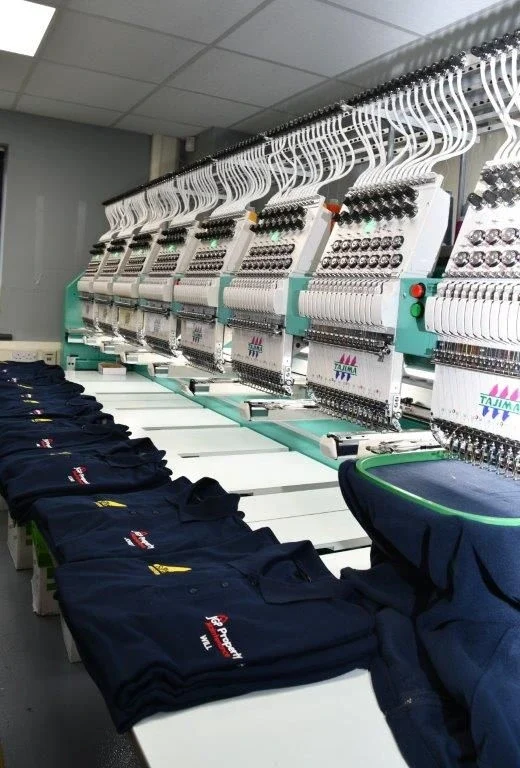
Small, simple logos at the chest, sleeve, nape and cap suit embroidery: the raised thread looks premium and copes with frequent washing. Large designs on the back suit print, because a big area of solid stitching becomes heavy and stiff; Essential Workwear recommends DTF or screen printing for full backs and print rather than embroidery on hi-vis (Essential Workwear). Many uniforms combine the two: an embroidered chest logo with a printed back. Our guide to embroidery vs printing compares the methods in detail.
Readability and small text
A logo that looks crisp on screen can blur at 8 cm wide in thread. Printful sets the minimum letter height for an embroidered logo at 0.25 inches, about 6 mm (Printful). Fine lines, small slogans and gradients survive better in DTF printing, so if your logo carries a strapline, consider a simplified version for embroidery and keep the full version for the back print.
Logos on hi-vis
On hi-vis the logo has to fit around the safety materials. EN ISO 20471 sets minimum areas of fluorescent and retroreflective material for each class, and the garment must still meet them once the logo is added; our guide to hi-vis classes and EN ISO 20471 explains the figures. Essential Workwear warns that a logo covering the reflective tape may cause the garment to fail the standard, and suggests the upper chest above the chest tape or the upper back between the tapes (Essential Workwear). Decide the logo before the garment is made and tested, not afterwards.
How to brief your supplier
A clear brief avoids a second round of changes. For each logo, send:
- The artwork as a vector file (PDF, AI or SVG), with Pantone references for the colours.
- The position, described from a fixed point: for example, left chest, centred between the placket and the side seam.
- A target size, as a maximum width or height in centimetres.
- The method you have in mind, or ask the supplier to recommend one for the fabric.
- The size range of the order, since the same logo looks larger on an XS than on a 3XL.
Then check the mock-up carefully: position, size, colours and spelling. That approved mock-up is what production follows.
Uniforms with your logo from Desa & Co
We embroider and DTF print in our own workshop in Tirana, so a chest logo and a back print on the same garment come from one place. Our minimum is 100 to 150 pieces per product, with sizes and colours mixed within it, and production of the minimum quantity takes 2 weeks after design approval. Our cotton is certified to OEKO-TEX® Standard 100 and the company to ISO 9001, ISO 14001 and ISO 45001; we deliver to the United Kingdom, Italy and across Albania. We make hi-vis to the standard and class you specify and supply a sample for you to have tested; we don't hold a hi-vis certificate of our own. See our embroidered polo shirts and custom workwear, or send us your logo and garments for a quote.
Frequently asked questions
Which side of the shirt does a logo go on?
By convention, the wearer's left chest. If the garment already carries a brand mark there, or the staff name badge goes on the left, the right chest is the usual alternative.
Can I put a logo on a pocket?
Yes, on the pocket flap or just above the pocket. Embroidering through a pocket can stitch it closed, so tell your supplier whether the pocket must stay usable.
Need clothing made for your team?
Send us the product, the quantity and your logo, and we will reply with a quote and a delivery date.
Request a quoteKeep reading
What Is Sublimation Printing on Clothing?
How dye sublimation works, from transfer paper to heat press, why it needs white or light polyester, its strengths and limits, how it compares with DTF and embroidery, and why football kits are made this way.
Uniform Tax Rebate: Who Can Claim and How
A plain-English summary of the UK uniform tax rebate: who qualifies, what counts as a uniform for HMRC, the flat rate amounts by job, how to claim for the current tax year and the 4 previous ones, and what it means for employers ordering branded uniforms.
How to Wash Work Uniforms and Keep Logos Sharp
How to wash branded polos, T-shirts, hoodies, workwear, hi-vis, scrubs and chef whites so the logo and the colour last: care labels, temperatures, drying, ironing and who washes PPE.